
OCD or GAD?
Stop Missing What’s Right in Front of You
A 2-minute mini lesson for therapists on the most commonly misdiagnosed anxiety patterns and how to avoid reinforcing OCD without realizing it.
What You’ll Learn in 2 Minutes:
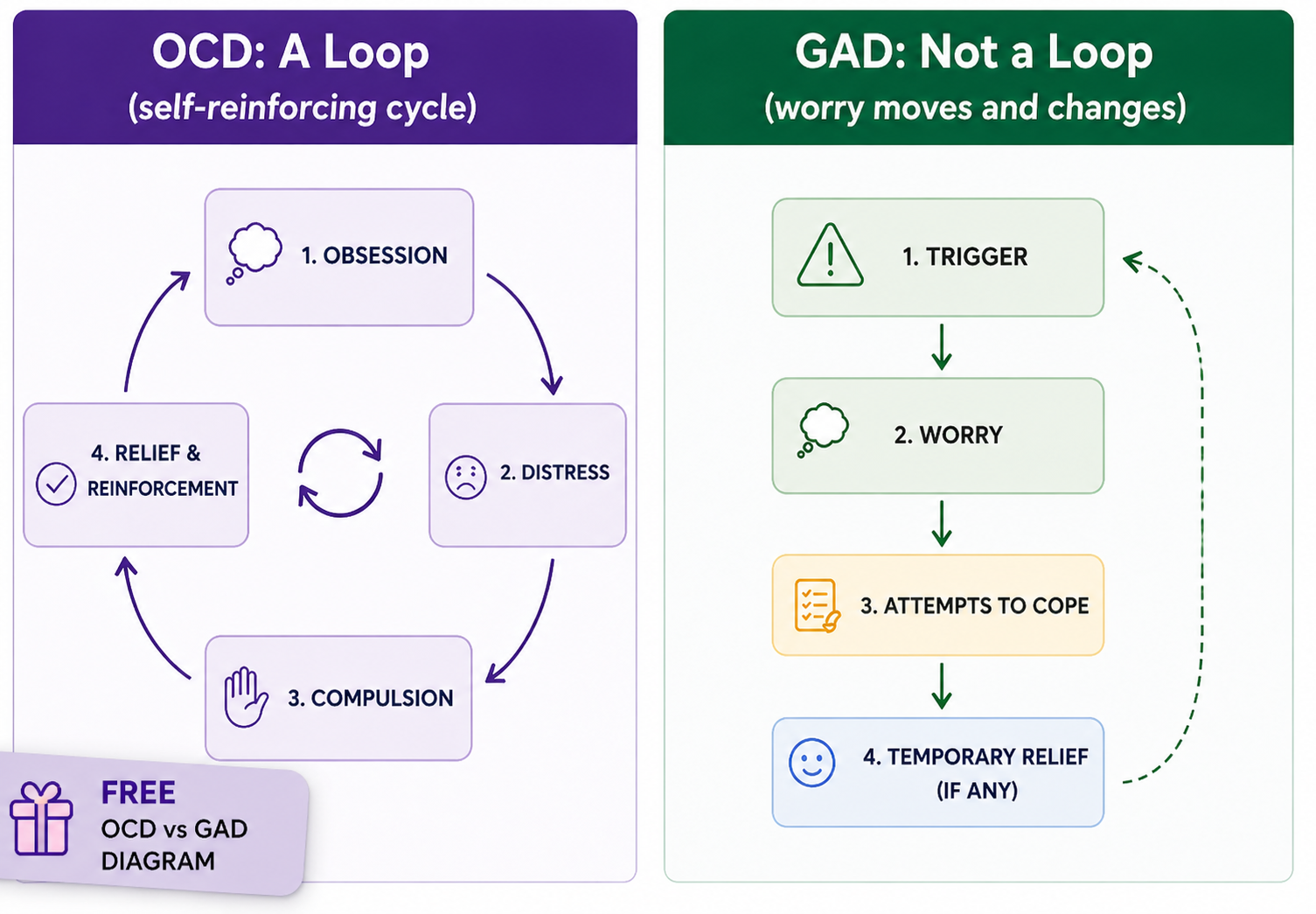
The key difference between OCD and GAD (that most clinicians overlook)
Why reassurance and coping skills can backfire in OCD
A simple framework you can use immediately in session
Many clients labeled as “generalized anxiety” are actually struggling with OCD. When we miss it, even well-intentioned coping strategies can make symptoms worse.
This quick training will help you:
Spot the difference fast
Understand the function of the behavior
Avoid common treatment mistakes
What to Do in an OCD Spiral (That Isn’t Reassurance)
A short, OCD-informed tool you can use in session or teach clients without reinforcing compulsions
Most clinicians worry that mindfulness can become a compulsion in OCD treatment.
They’re not wrong.
When clients use tools to feel better or get certainty, it can quietly reinforce the OCD cycle.
This is why I created Pause Without Fixing.
A simple, OCD-informed approach that helps clients:
notice thoughts without engaging
sit with urges without responding
pause without trying to fix or get certainty
This is not about reducing anxiety.
It is about changing your relationship to it.
When you download this, you’ll get:
A 7-minute guided audio you can use in session
A therapist-ready script (PDF)
OCD-informed psychoeducation
I help clinicians recognize OCD more clearly and avoid common treatment patterns that can unintentionally keep clients stuck.
This is part of a growing collection of OCD-informed tools for therapists.
If this is helpful, I also share practical resources on:
recognizing OCD more clearly
avoiding common treatment pitfalls
applying ERP in real clinical settings